Digital Twin vs Simulation: What’s the Difference?
Dec 23, 2025
Digital Twin vs Simulation: A Quick Answer
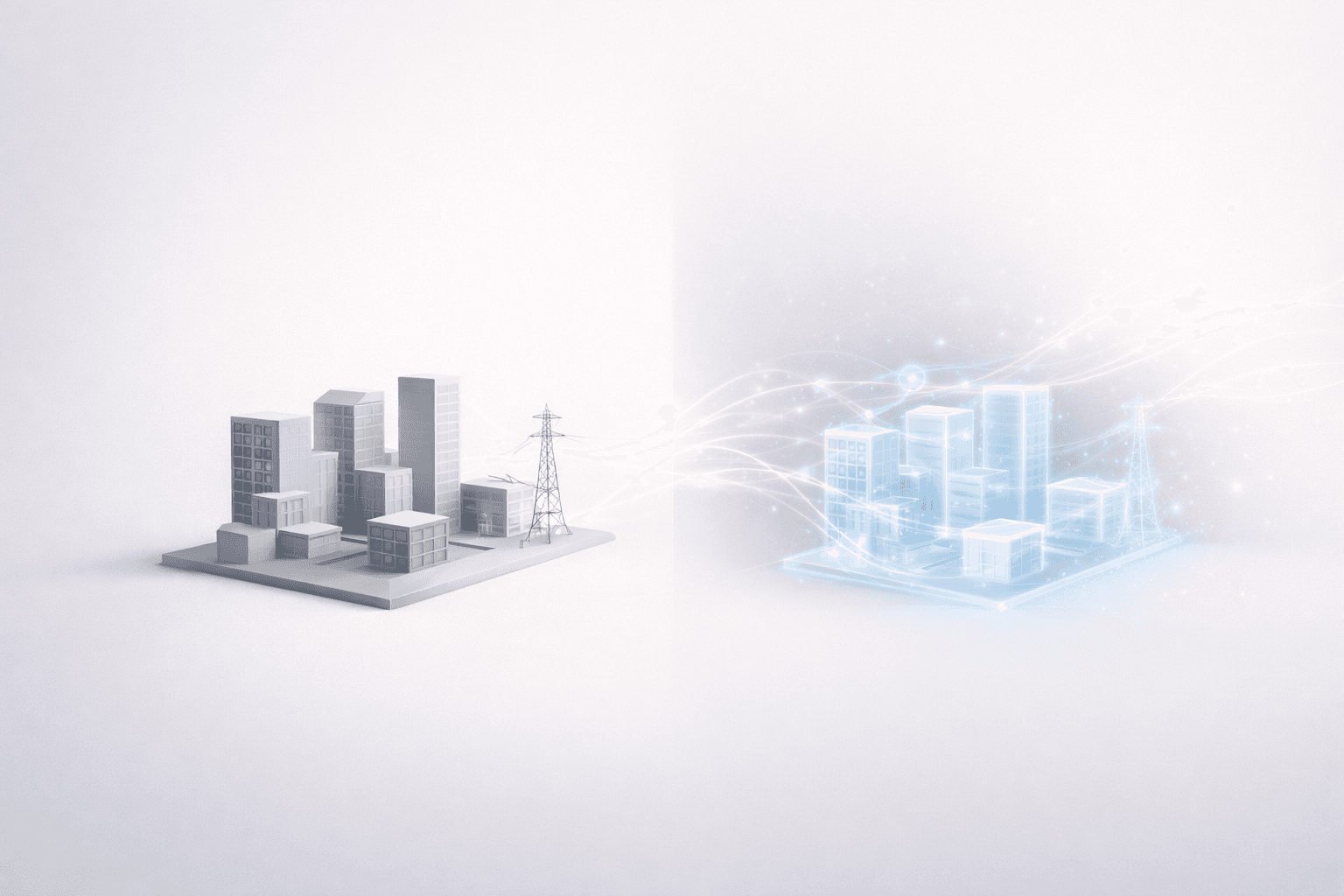
The difference between a digital twin and a simulation comes down to connection and continuity.
A simulation is a static model used to test scenarios.
A digital twin is a continuously updated virtual representation of a real-world system.
Both are useful—but they solve different problems.
What Is a Simulation?
A simulation is a model designed to imitate how a system might behave under specific conditions.
Simulations typically:
Run using assumed or historical data
Represent a single moment or scenario
Are disconnected from live systems
End once the scenario is complete
Simulations are often used to answer questions like:
What would happen if demand doubled?
How might this system behave under stress?
Which option performs best in theory?
They are powerful tools for planning, testing, and education.
What Is a Digital Twin?
A digital twin is a virtual representation of a real-world object, system, or process that stays connected to its real counterpart over time.
Unlike simulations, digital twins:
Continuously ingest real-world data
Update as conditions change
Persist across time, not just scenarios
Reflect actual behavior, not just assumptions
A digital twin answers questions like:
What is happening right now?
Why is performance changing?
What is likely to happen next?
If you’re new to the concept, this builds directly on the definition covered in “What Is a Digital Twin?” (Day 1).
Digital Twin vs Simulation (Side-by-Side Comparison)
Simulation | Digital Twin |
|---|---|
Static | Continuously updated |
Scenario-based | Reality-based |
Uses assumed or historical data | Uses live and historical data |
Disconnected from real systems | Actively linked to real systems |
Ends after execution | Persists over time |
Best for planning | Best for monitoring and optimization |
In short:
Simulations explore possibilities
Digital twins observe and evolve with reality
When a Simulation Makes More Sense
Simulations are often the better choice when:
Real-world data is unavailable
You’re early in design or planning
The system doesn’t yet exist
You want to test hypothetical extremes
Cost or risk prevents live experimentation
Common examples include:
Engineering design tests
Financial stress testing
Training environments
Academic or research models
Simulations are especially effective when the goal is learning, not continuous optimization.
When a Digital Twin Makes More Sense
Digital twins are the better choice when:
The real system already exists
Data is continuously available
You need ongoing insight, not one-time answers
Performance changes over time
Decisions depend on current conditions
Common examples include:
Manufacturing equipment monitoring
Supply chain optimization
Software system observability
Customer behavior modeling
AI-driven personalization systems
Digital twins shine when the goal is adaptation and prediction, not just analysis.
How Simulations and Digital Twins Work Together
In practice, simulations and digital twins are not mutually exclusive.
Many digital twins use simulations internally.
For example:
A digital twin may run simulations to test future outcomes
The results feed back into real-world decisions
The twin updates again as new data arrives
Think of it this way:
Simulations are tools
Digital twins are systems
One can exist inside the other.
Why This Difference Matters for AI Systems
Modern AI systems depend heavily on:
Context
Feedback loops
Memory over time
Simulations provide snapshots.
Digital twins provide continuity.
This is why digital twins are increasingly used to:
Give AI persistent context
Ground predictions in real behavior
Enable learning beyond one-off datasets
For intelligent systems, the difference between simulation and digital twin often determines whether AI is reactive or adaptive.
A Simple Analogy
A simulation is like a flight simulator:
You test scenarios
You reset when you’re done
A digital twin is like live air traffic control:
It reflects what’s happening now
It updates continuously
Decisions have real consequences
Both are valuable—but for different purposes.
Final Thoughts
Simulations and digital twins are closely related, but they are not interchangeable.
Use a simulation when you need to explore possibilities.
Use a digital twin when you need to understand and optimize reality over time.
As systems become more data-rich and AI-driven, the shift from simulation to digital twin becomes not just helpful—but necessary.
Frequently Asked Questions
Is a digital twin just a more advanced simulation?
No. While digital twins may use simulations, they are defined by continuous connection to real-world data.
Can a simulation become a digital twin?
Yes. A simulation can evolve into a digital twin once it is connected to live data and maintained over time.
Do digital twins always require real-time data?
Not always, but near-real-time data significantly increases their usefulness.
Which is better for AI applications?
Digital twins are generally better because they provide ongoing context, feedback, and adaptation.