How Digital Twins Work: Architecture, Data, and Real-Time Feedback
Dec 24, 2025
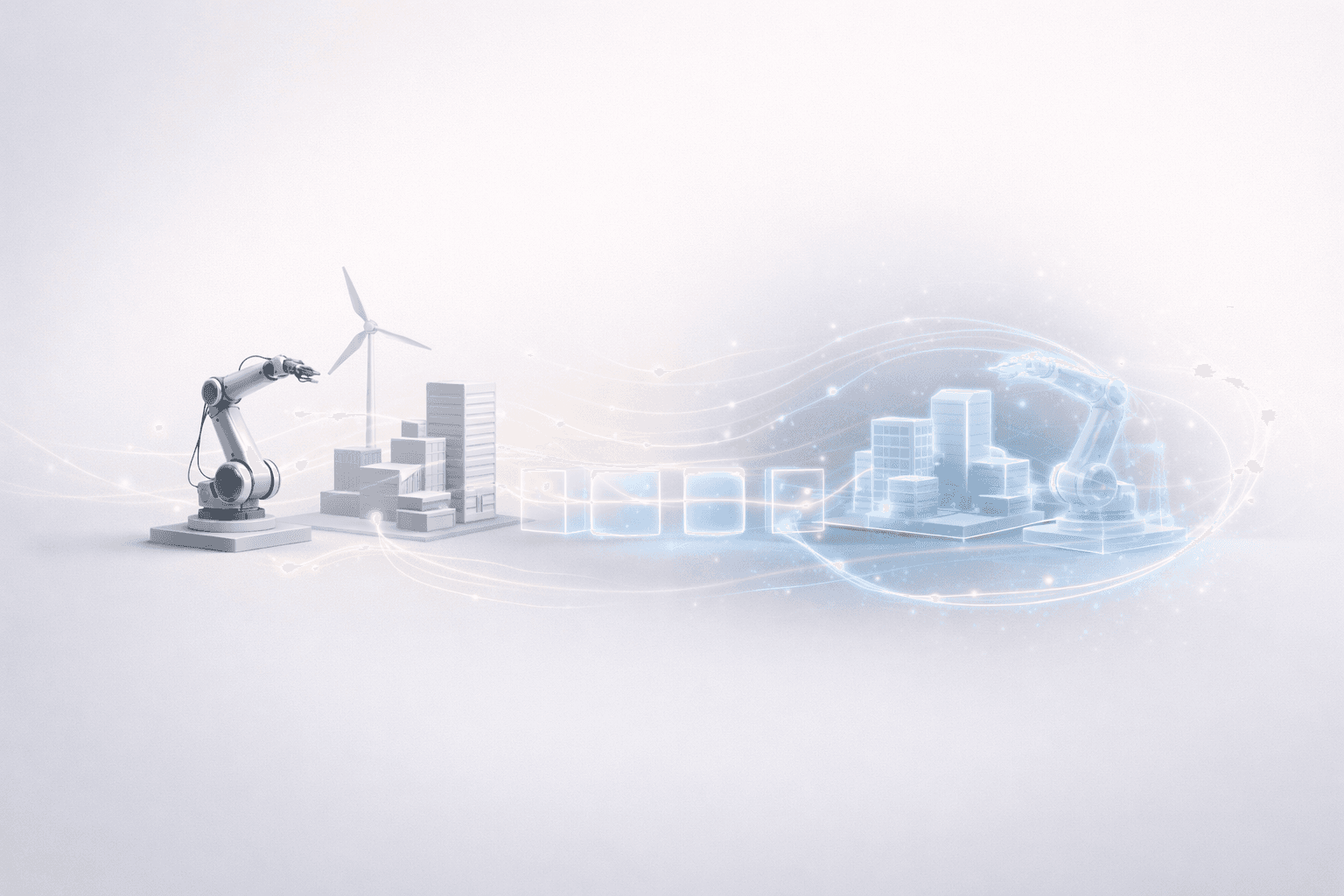
How Digital Twins Work (High-Level Overview)
At a high level, digital twins work by continuously connecting real-world data to a virtual model that updates, learns, and responds over time.
Unlike static diagrams or one-time simulations, a digital twin is a living system. Its accuracy depends on how well data flows, how models interpret that data, and how feedback loops are maintained.
To understand how digital twins work in practice, it helps to break them down into architecture, data, and feedback.
Core Components of Digital Twin Architecture
Most digital twin architectures—regardless of industry—share the same foundational layers.
1. The Physical or Source System
This is the real-world entity being mirrored. It can be:
A machine or device
A software system
A process or workflow
A person or behavior pattern
The key requirement is that the system produces observable data.
2. Data Collection Layer
This layer captures signals from the source system.
Depending on context, data may come from:
Sensors (temperature, movement, pressure, usage)
APIs and system logs
User actions and events
External data sources
Data does not need to be perfect—but it must be consistent and reliable.
Without this layer, a digital twin cannot stay aligned with reality.
3. Data Pipeline and Processing Layer
Raw data is rarely usable as-is.
This layer is responsible for:
Cleaning and validating data
Normalizing formats
Handling latency or missing inputs
Streaming or batching data appropriately
In modern systems, this often includes:
Event streams
Message queues
Time-series databases
This layer determines how “real-time” the digital twin actually is.
4. The Digital Model Layer
This is the core of the digital twin.
The model represents:
Structure (what exists)
State (what’s happening now)
Behavior (how it changes over time)
Models can be:
Rules-based
Mathematical or statistical
Machine learning–driven
Hybrid (most real systems)
The model is what turns raw data into meaning.
5. Feedback and Update Loop
This is what makes a digital twin a digital twin.
As new data arrives:
The model updates its state
Predictions or insights are recalculated
Outputs influence decisions or actions
Those actions generate new data
This creates a continuous feedback loop between the real system and its digital counterpart.
Without feedback, you don’t have a twin—you have a dashboard.
Real-Time vs Near-Real-Time Digital Twins
Not all digital twins operate in true real time.
There are three common timing models:
Real-time: Updates occur instantly or within seconds
Near-real-time: Updates occur with small delays (minutes)
Periodic: Updates occur on a fixed schedule
The right choice depends on:
Cost
System complexity
Decision urgency
What matters is temporal relevance, not speed for its own sake.
How Data Flows Through a Digital Twin (Step-by-Step)
A simplified flow looks like this:
The real system generates data
Data is captured and transmitted
The pipeline processes and validates inputs
The digital model updates its internal state
Insights, predictions, or alerts are produced
Decisions or actions are taken
New data reflects those changes
This loop repeats continuously.
Over time, the digital twin becomes more accurate—not because it’s static, but because it learns.
Why Feedback Loops Matter
Feedback loops are what allow digital twins to move beyond monitoring into optimization.
They enable:
Drift detection
Performance tuning
Predictive maintenance
Behavioral adaptation
In AI-driven systems, feedback loops are especially critical because they provide:
Context over time
Memory of past outcomes
Grounding for predictions
Without feedback, intelligence plateaus.
Digital Twin Architecture vs Traditional Monitoring Systems
Traditional monitoring systems focus on:
Metrics
Thresholds
Alerts
Digital twins focus on:
State
Relationships
Change over time
A monitoring system tells you what broke.
A digital twin helps you understand why it’s changing and what will happen next.
Scaling Digital Twin Architecture
As digital twins scale, architecture must handle:
More data sources
Higher data velocity
More complex models
Multiple interacting twins
This often leads to:
Modular architectures
Distributed systems
Model versioning
Governance around data and behavior
At scale, digital twins become platforms—not features.
Digital Twins in Software and AI Systems
In software and AI contexts, the “physical” system may be abstract:
User behavior
Communication patterns
Decision workflows
The architecture remains the same:
Inputs
Models
Feedback
What changes is the nature of the data and the speed at which systems adapt.
This is where digital twins begin to resemble intelligent counterparts, not just technical representations.
Final Thoughts
Understanding how digital twins work requires thinking in systems, not tools.
A digital twin is not:
A dashboard
A single model
A one-time simulation
It is an architecture built around data, models, and feedback loops that evolve together.
As real-world systems become more complex and AI-driven, this architecture is becoming foundational—not optional.
Frequently Asked Questions
Do digital twins always require sensors?
No. Sensors are common in physical systems, but software and behavioral twins often rely on events, logs, and user actions instead.
How real-time does a digital twin need to be?
Only as real-time as the decisions it supports. Many effective digital twins operate in near-real-time.
Can a digital twin exist without AI?
Yes. AI enhances digital twins, but rules-based and statistical models can also power effective twins.
Is digital twin architecture expensive to build?
It depends on scope and scale. Many systems start small and evolve as data maturity increases.