Types of Digital Twins Explained (Product, Process, System)
Dec 23, 2025
Why “Types of Digital Twins” Matter
As digital twins become more common, the term itself is being used to describe very different things.
Some digital twins model machines.
Others model workflows.
Others model entire systems—or even behavior.
Understanding the types of digital twins helps clarify:
What problem you’re solving
How complex your architecture needs to be
What kind of data and models are required
Most confusion around digital twins comes from mixing these categories.
The Three Core Types of Digital Twins
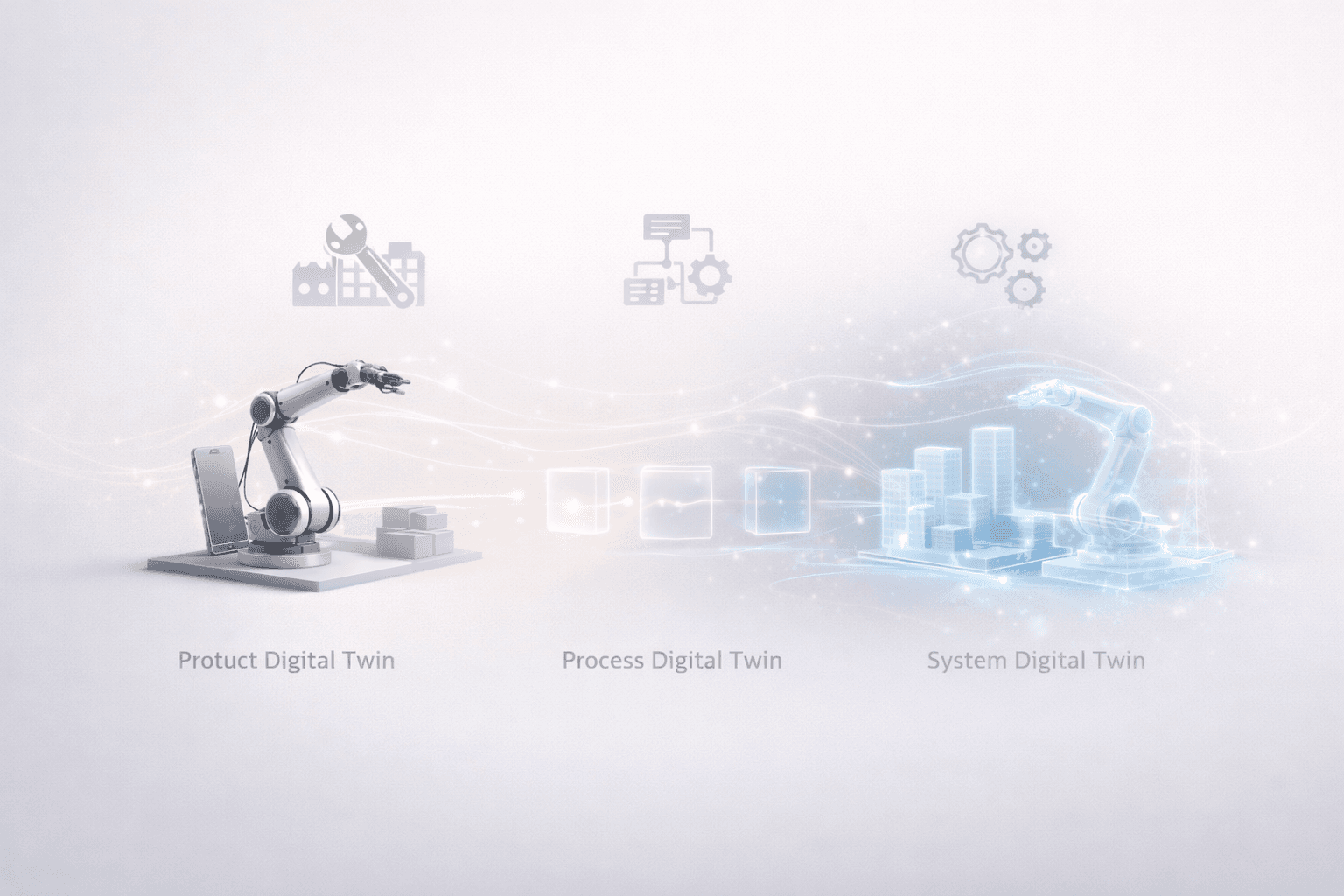
While implementations vary, most digital twins fall into three primary categories:
Product Digital Twins
Process Digital Twins
System Digital Twins
These types are not mutually exclusive—but they are conceptually distinct.
Product Digital Twins
What Is a Product Digital Twin?
A product digital twin represents a single physical or digital product across its lifecycle.
It mirrors:
Design specifications
Operating conditions
Usage patterns
Performance over time
Product digital twins are often the first entry point into digital twin adoption.
Common Use Cases
Product digital twins are widely used for:
Design validation
Performance monitoring
Predictive maintenance
Quality control
Examples include:
Industrial equipment
Vehicles
Consumer devices
Hardware-enabled software products
What Data Powers Product Digital Twins?
Typical data sources include:
Sensors
Telemetry
Usage logs
Maintenance records
The focus is on how a specific product behaves in the real world, not just how it was designed.
Process Digital Twins
What Is a Process Digital Twin?
A process digital twin represents a workflow, operation, or sequence of actions rather than a physical object.
It models:
Inputs and outputs
Dependencies
Timing and flow
Bottlenecks and inefficiencies
Process digital twins are about how work happens.
Common Use Cases
Process digital twins are often used to optimize:
Manufacturing lines
Supply chains
Payment flows
Customer onboarding
Operational workflows
They help answer questions like:
Where is friction occurring?
Why is throughput changing?
What happens if we adjust one step?
What Data Powers Process Digital Twins?
Process twins rely on:
Event data
Transaction logs
System timestamps
Performance metrics
They are especially powerful in software and service-based businesses where processes are data-rich.
System Digital Twins
What Is a System Digital Twin?
A system digital twin combines multiple components—products, processes, and interactions—into a unified model.
It represents:
Relationships between components
Emergent behavior
System-wide performance
Trade-offs across subsystems
System digital twins focus on the whole, not the parts.
Common Use Cases
System digital twins are used for:
Factories and facilities
Smart cities
Complex platforms
Enterprise software ecosystems
They are critical when optimizing one part of a system impacts others.
What Data Powers System Digital Twins?
System twins aggregate data from:
Multiple products
Multiple processes
External dependencies
They require more sophisticated modeling, governance, and orchestration than simpler twins.
How These Digital Twin Models Relate
These types are best understood as layers—not silos.
For example:
A product digital twin may feed data into a process twin
Multiple process twins may roll up into a system twin
Insights at the system level may influence product behavior
Most mature implementations involve multiple digital twin models working together.
Beyond the Core Types: Behavioral and Software Twins
As digital twins expand beyond physical systems, new categories are emerging.
These include:
Behavioral digital twins
Software and AI digital twins
Customer or user digital twins
While not always classified alongside product, process, and system twins, they follow the same architectural principles:
Inputs
Models
Feedback loops
The difference lies in what is being represented.
Choosing the Right Type of Digital Twin
The right type depends on your goal:
If you’re optimizing a thing, start with a product twin
If you’re optimizing how work flows, use a process twin
If you’re optimizing interactions and trade-offs, you need a system twin
Many organizations begin small and expand as data maturity increases.
Why This Classification Matters for AI
AI systems depend on context.
Different digital twin types provide different kinds of context:
Product twins provide state
Process twins provide flow
System twins provide relationships
When paired correctly, digital twins give AI the grounding it needs to move from prediction to decision-making.
Final Thoughts
Digital twins are not a single technology—they are a family of models.
Understanding the types of digital twins helps avoid overengineering, under-scoping, and misaligned expectations.
As organizations move toward more intelligent, adaptive systems, these distinctions become essential—not academic.
Frequently Asked Questions
Can one digital twin be both a product and a process twin?
Yes. Many real-world implementations overlap, especially when product behavior directly affects workflows.
Are system digital twins always more complex?
Typically yes, because they involve more components and interactions—but they also deliver broader insight.
Do all businesses need system digital twins?
No. Many businesses start with product or process twins and only move to system twins as complexity grows.
Are behavioral digital twins a separate category?
They are often treated as an extension of process or system twins, depending on scope and data.